
For many entrepreneurs and executives across Latin America, expanding into the United States is a natural next step. The appeal is understandable: the U.S. offers access to a large consumer economy, sophisticated enterprise customers, deep capital markets, established innovation ecosystems, and opportunities to build globally recognized brands.
Yet one of the most common strategic mistakes companies make happens before they open an office, hire their first employee or approach their first prospective customer. They treat the United States as a single, homogeneous market. It isn’t.
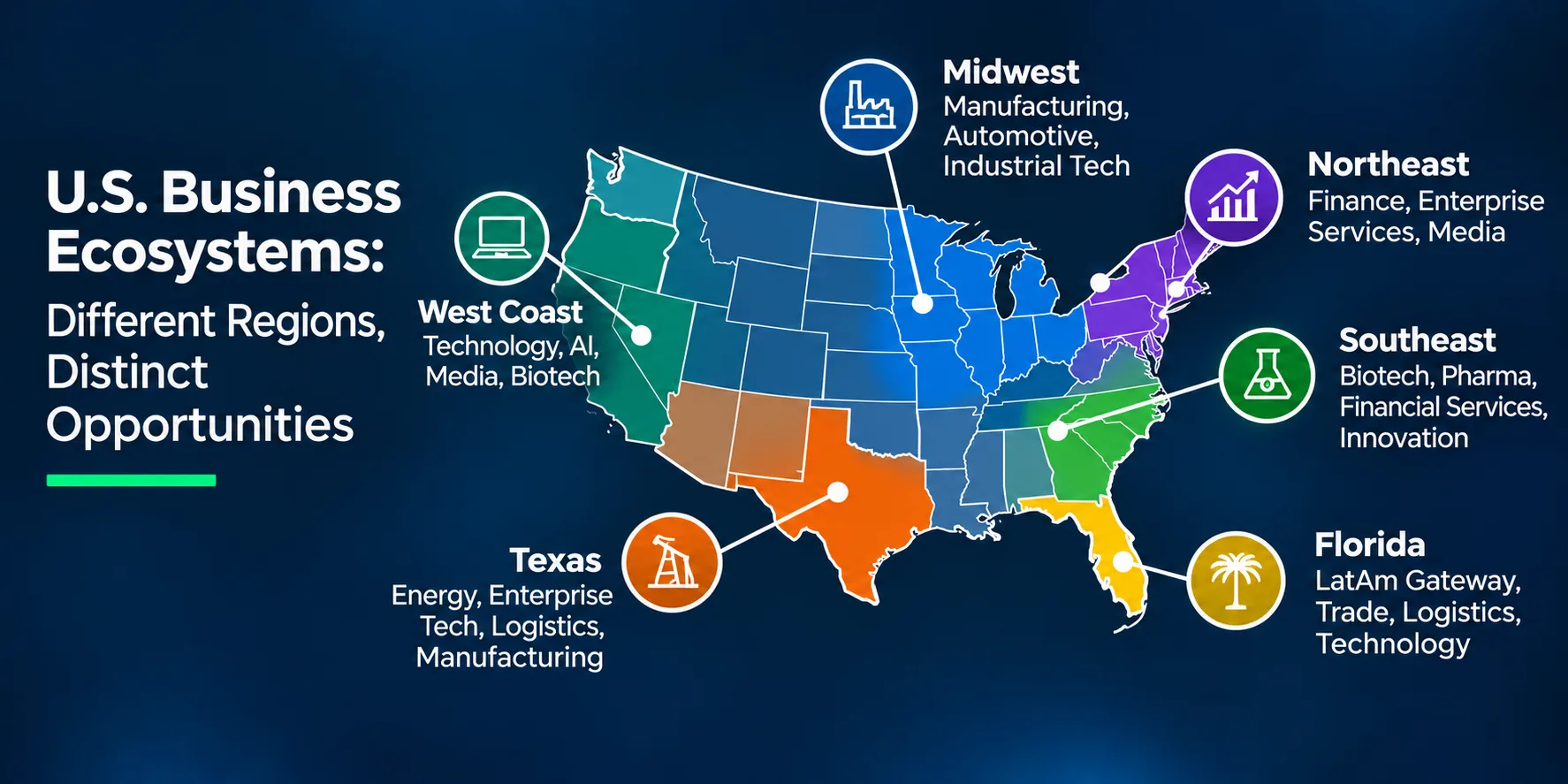
The United States consists of 50 states, each with its own economic characteristics, regulatory environment, industry concentrations, labor market, business culture and competitive landscape. While the country operates under a shared federal framework, doing business in California can be dramatically different from operating in Texas, Florida, North Carolina or Massachusetts.
For Latin American companies, understanding these differences is not simply a matter of geography.
It can determine whether an expansion strategy succeeds or fails.
A $30 trillion economy, but not a uniform one
The United States generated approximately $29.2 trillion in nominal GDP in 2024, according to the U.S. Bureau of Economic Analysis. That figure alone makes it an extraordinary destination for international expansion. However, the national number conceals significant regional differences.
California’s economy, for example, is larger than that of most countries. Texas has developed an economic environment particularly attractive to energy, manufacturing, logistics and enterprise technology businesses. New York remains a major global center for finance, professional services and media. Meanwhile, states such as North Carolina have built strong positions in biotechnology, pharmaceuticals, financial services and research-driven industries.
These are not interchangeable markets. A Brazilian software company specializing in financial technology may find its strongest opportunities in New York, Charlotte or selected Texas markets. A Mexican manufacturer seeking proximity to customers and supply chains may find Texas or other Southern and Southwestern states more strategically relevant. A Colombian health technology company might benefit from building relationships within Boston’s life sciences ecosystem or North Carolina’s Research Triangle.
The question should not simply be how do we enter the United States? It should be:
Where in the United States does our business have the greatest probability of succeeding, and why?
Geography is strategy
One of the defining characteristics of the American economy is the concentration of industries within regional ecosystems. These clusters bring together customers, suppliers, universities, investors, specialized talent and service providers. For international companies, proximity to the right ecosystem can significantly accelerate market understanding and relationship development.
California: technology, innovation and global connectivity
California is often the first destination that comes to mind when Latin American technology companies consider entering the United States. Silicon Valley and the San Francisco Bay Area remain major centers for venture capital, artificial intelligence, enterprise software and emerging technologies. Los Angeles offers a different environment, with significant opportunities across entertainment, digital media, aerospace, consumer brands, logistics and technology. San Diego brings additional strengths in biotechnology, telecommunications, defense and life sciences.
But California also presents challenges. Operating costs can be substantial, competition is intense, and certain regulatory requirements are more demanding than in other states. For companies seeking investors, technology partnerships or access to advanced innovation ecosystems, California may be an excellent choice. For companies prioritizing lower operating costs or proximity to particular industrial customers, another state may offer a better starting point.
Texas: enterprise technology, energy and industrial growth
Texas has become an increasingly important destination for companies pursuing U.S. expansion. Austin has established itself as a technology and startup hub, while Dallas–Fort Worth offers a large corporate ecosystem encompassing financial services, telecommunications, logistics and enterprise technology. Houston remains particularly relevant for energy, engineering, healthcare and international trade.
For Latin American companies, Texas can offer a combination of geographic accessibility, established commercial relationships and a diversified business environment. Its connections with Mexico are particularly important, although opportunities extend well beyond cross-border manufacturing and trade.
Texas also illustrates why choosing a state is only the beginning. Austin, Dallas and Houston serve different industries and customer profiles, and a strategy that works in one metropolitan area may not translate directly to another.
Florida: a gateway to Latin America, but not always the final destination
Miami has long served as a commercial bridge between Latin America and the United States. Its international business community, bilingual professional networks, transportation infrastructure and familiarity with Latin American markets make it an attractive entry point. For many companies, it offers a relatively accessible environment in which to establish initial operations and build relationships.
However, there is an important distinction between establishing a U.S. presence and reaching the American customers a company ultimately wants to serve. A Latin American technology company can successfully establish an office in Miami while discovering that its primary enterprise buyers are concentrated in New York, Texas, California or the Midwest.
Miami can be an excellent operational and relationship-building base, but choosing it solely because of cultural familiarity can limit a company’s commercial strategy. The best locations for incorporation, management, sales and customer acquisition do not need to be the same.
New York: finance, enterprise services and global business
New York remains one of the world’s most influential business centers. Its concentration of financial institutions, investment firms, professional services organizations, media companies and multinational corporations creates significant opportunities for international businesses. For fintech companies, financial software providers, cybersecurity firms and specialized B2B service companies, the New York metropolitan area may offer direct access to important decision-makers.
The trade-off is a highly competitive environment where customer expectations are sophisticated and differentiation is essential. Entering New York without a clearly defined value proposition can become expensive very quickly.
North Carolina: technology, research and financial services
North Carolina deserves greater attention from Latin American companies evaluating U.S. opportunities. Charlotte has developed into one of the country’s major banking and financial services centers. The Research Triangle, encompassing Raleigh, Durham and Chapel Hill, benefits from universities, research institutions, biotechnology companies and a growing technology ecosystem. The state also offers opportunities in manufacturing, pharmaceuticals and business services.
For companies whose offerings align with these sectors, North Carolina may provide access to relevant customers and specialized talent without requiring a presence in the country’s most expensive technology markets.
The Midwest: an often-overlooked opportunity
Latin American companies frequently focus on the East and West Coasts, overlooking substantial opportunities in the Midwest. Illinois, Michigan, Ohio, Indiana, Missouri and neighboring states have deep industrial capabilities and established business networks. Chicago is a major center for finance, logistics, professional services, manufacturing and food-related industries, and Michigan remains important to automotive manufacturing and mobility technologies. Other Midwestern markets offer opportunities in agricultural technology, industrial automation, transportation, healthcare and supply chain management.
For Latin American companies with experience in manufacturing, agribusiness, logistics or industrial software, these markets may provide a stronger commercial fit than more visible technology hubs. The most recognizable city is not necessarily the city with the best customers.
The cultural familiarity trap
One advantage Latin American companies bring to the United States is their ability to operate across different cultural environments. Many executives have experience navigating complex markets, managing distributed teams and adapting products or services to different customer expectations.
Yet cultural familiarity can also become a strategic limitation. It is natural for a Brazilian, Mexican, Argentine or Colombian entrepreneur to gravitate toward communities where their language is spoken and their professional network is already established. These relationships can be valuable, particularly during the initial stages of expansion, but they should not substitute for market validation.
A company that builds its entire U.S. strategy around existing Latin American connections risks creating a business that operates geographically in the United States while remaining commercially dependent on its original network. That may be a viable business model, but it is different from achieving broader penetration of the American market.
Successful expansion requires understanding how local customers evaluate suppliers, make purchasing decisions, negotiate contracts and establish trust. This often means moving beyond familiar networks and developing relationships directly within the industries and regions the company intends to serve.
Market entry is not the same as company formation
Another common misconception is that opening a U.S. company represents meaningful market entry. Forming an LLC or corporation, obtaining a federal tax identification number, opening a bank account and establishing a business address are important administrative steps. But they do not, by themselves, create demand.
A U.S. legal entity is not a go-to-market strategy.
Before committing substantial resources, companies should understand several critical questions:
- 01Who is the ideal American customer, and where are those customers concentrated?
- 02What problem does the company solve better or more efficiently than existing alternatives?
- 03Who are the local competitors, and how do they position themselves?
- 04What regulatory, tax, licensing or contractual requirements apply?
- 05Which distribution channels, strategic partners or industry relationships could accelerate market access?
- 06What level of localization is necessary for the product, service, pricing and commercial approach?
The answers may point toward a very different expansion strategy than the one initially envisioned. One company may discover that it can validate demand through a local commercial representative or strategic partnership before establishing a substantial physical operation. Another may find that acquiring a small existing business offers better market access than building a customer base from scratch.
There is no universally correct model. The appropriate structure depends on the company’s industry, objectives, resources and stage of development.
The importance of being in the right room
Business development in the United States is often highly relationship-driven, particularly in enterprise markets. Conferences, executive roundtables, industry associations, innovation centers and professional communities can create valuable opportunities to meet customers and partners. However, attending events without a clear strategy rarely produces meaningful results.
A Latin American company can spend thousands of dollars attending a major technology conference while meeting very few people who influence purchasing decisions in its target industry. Conversely, a smaller regional event focused on a specific sector may generate far more relevant conversations.
This is where understanding local business ecosystems becomes particularly important. A company selling solutions to financial institutions should prioritize environments where financial services executives and technology decision-makers are present. A business developing industrial automation solutions may find greater value in manufacturing associations, industry-specific conferences and regional supplier networks. A healthcare technology company may need to engage with hospital systems, healthcare operators, specialized investors and relevant professional organizations.
The objective should not be to attend as many events as possible. It should be to create the highest possible concentration of relevant conversations.
Why benchmarking should come before expansion
One of the most valuable steps a company can take before entering the United States is structured market discovery. This means going beyond online research and engaging directly with the market. Executive benchmarking visits, curated meetings, industry conversations and targeted participation in business events can provide insights that are difficult to obtain from secondary research alone.
A well-designed discovery program can help executives understand:
- 01Customer expectations: how American buyers evaluate solutions, suppliers, service levels and pricing.
- 02Competitive positioning: how established companies communicate value and differentiate their offerings.
- 03Technology adoption: which innovations are gaining practical traction within a particular industry.
- 04Partnership opportunities: which organizations could serve as distribution partners, technology collaborators or strategic introductions.
- 05Regional differences: whether the company’s strongest opportunities are concentrated in a particular state, metropolitan area or industry cluster.
These conversations can also challenge assumptions. An executive may arrive believing that California is the natural destination for a technology business, only to discover that the company’s most promising customers are in Texas or North Carolina. Another may learn that the U.S. market requires a different pricing structure, product positioning or service delivery model.
The purpose of benchmarking is not simply to observe successful companies. It is to make better strategic decisions before committing capital.
A more practical approach to U.S. expansion
For Latin American companies, a disciplined market-entry strategy should generally follow five stages:
- 01Define the commercial objective. Is the priority revenue growth, access to enterprise customers, technology partnerships, investment, geographic diversification or a long-term operational presence? Different objectives may require different geographic strategies.
- 02Identify the most relevant markets. Evaluate states and metropolitan areas based on industry concentration, customer accessibility, competitive intensity, operating costs and regulatory considerations. Avoid choosing a location solely because it is familiar or internationally recognizable.
- 03Validate assumptions through direct engagement. Meet potential customers, industry executives, partners and ecosystem participants to test the value proposition, understand purchasing processes and identify barriers to entry.
- 04Build a focused go-to-market strategy. Develop a commercial approach tailored to the selected market, through local representation, strategic partnerships, direct enterprise sales, channel development or a combination of these models.
- 05Expand based on evidence. Once the company demonstrates traction in its initial market, evaluate additional regions. Lessons from one state are valuable, but they should be adapted rather than automatically replicated elsewhere.
The opportunity for Latin America is significant
Latin American companies have important strengths that can translate into competitive advantages in the United States. The region has produced sophisticated technology companies, capable engineering teams, globally competitive manufacturers, innovative financial services businesses and entrepreneurs experienced in solving complex operational problems. Many have developed products and services under conditions that demand efficiency, adaptability and resourcefulness, and those capabilities are valuable in the American market.
However, competitive strengths must be translated into a value proposition that resonates with U.S. customers. Being successful in Brazil, Mexico, Colombia, Chile or Argentina does not automatically establish credibility with an American enterprise buyer. That credibility must be developed through market understanding, execution, relationships and demonstrated results. The opportunity is real, but success requires a strategy grounded in the realities of the specific markets a company intends to serve.
Think beyond the country
The United States offers extraordinary opportunities for Latin American businesses, but approaching it as a single market is a strategic oversimplification. Its 50 states represent different economic environments, and the distinctions become even more pronounced at the metropolitan and industry levels. The most effective expansion strategies recognize that geography, industry concentration, customer behavior and business relationships are interconnected.
For some companies, the right starting point will be Miami. For others, it may be Charlotte, Austin, Chicago, Boston, New York or San Francisco. And for many, the answer will involve more than one location, each serving a different strategic purpose. The objective is not simply to establish a presence in the United States, but to establish it where the company has the strongest opportunity to create sustainable commercial value.
Entering the United States is not about choosing a country. It is about choosing the right market within it.