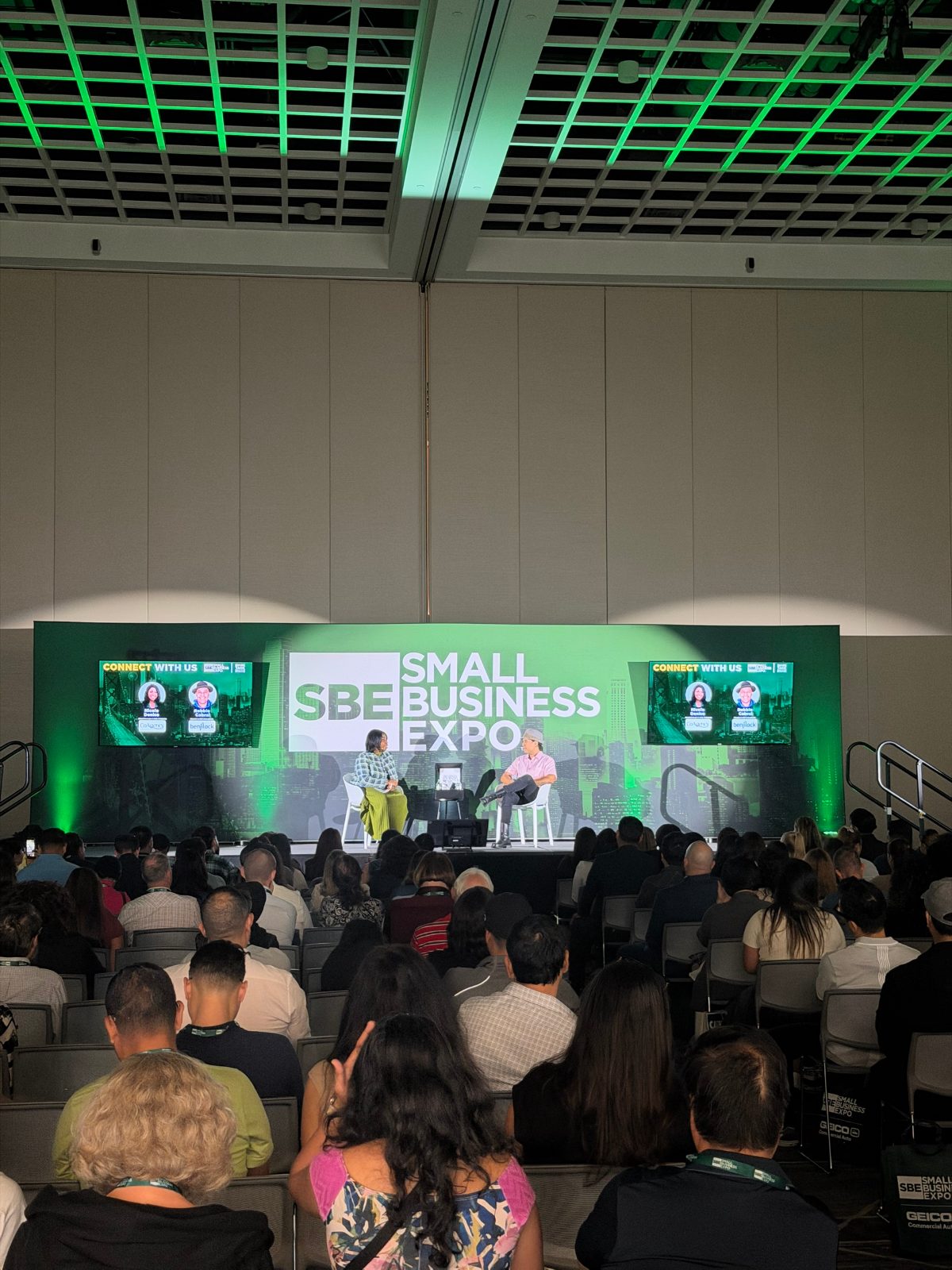
Today I spent the day at the Small Business Expo at the Pasadena Convention Center. Free admission, a busy exhibit hall and a full room for the main-stage sessions. It is a different crowd from the tech weeks and fintech conferences I usually write about: small business owners, franchisees, service providers and people getting ready to open their first location.
The topics, though, were familiar. Almost every conversation came back to the same four things: AI, optimization, franchising and the technology stack.
AI is on every booth, not yet in every business
AI was everywhere on the floor. Marketing, bookkeeping, phone answering, scheduling, content: nearly every vendor has added it to the pitch.
The data says adoption is still early for companies this size. The Census Bureau’s Business Trends and Outlook Survey puts AI use at roughly one in five US businesses this year, and fewer than one in five of the smallest firms. Larger companies are pulling ahead, while use among firms with fewer than 20 employees has barely moved since December.
That gap is the opportunity. The questions in the room were less about whether AI is real and more about where to start, what it will cost, and how to know if it worked.
Optimization before transformation
The word I heard most was not AI. It was optimization. Owners want fewer hours on admin, faster invoicing, less time chasing leads and fewer mistakes between systems. Most of that is solved by basic automation and cleaner processes long before it needs a model.
For a small business, the first AI project is usually a process project.
The stack problem
The most practical conversations were about the technology stack itself. A small business today can easily run a CRM, a POS, scheduling, payroll, accounting, email marketing, reviews, a website builder and a handful of AI subscriptions, each with its own login, its own data and its own monthly fee. Industry surveys put companies with fewer than 100 employees at dozens of SaaS applications.
Every new tool promises time back. Together, they often take it away: duplicated data, integrations nobody owns and subscriptions nobody remembers signing up for.
Before adding anything new, I would start with three questions:
- 01What does each tool actually do, and who uses it every week?
- 02Where does the same data live in two places?
- 03Which process is still manual because the tools don’t talk to each other?
Consolidating two or three tools, connecting the rest and automating the handoffs between them will usually do more for a small business than any single new AI product.
Franchising: buying a system
Franchising had a big presence, from franchisors recruiting new operators to people exploring their first unit. The International Franchise Association expects the number of US franchise establishments to grow about 1.5% in 2026, to roughly 845,000 units.
Part of the appeal is exactly the stack problem. A good franchise sells a proven system: brand, playbook, suppliers and, more and more, the technology. The franchisee does not have to choose between twenty scheduling tools. The flip side is that franchisors now have to get technology right for hundreds of operators at once, and AI raises that bar.
What this means
Small businesses don’t need an AI strategy first. They need a clear view of their processes, a lean stack that works together, and then AI where it removes real work.
That is the same advice I give larger companies. The difference is that small businesses feel the cost of a bad stack every month, in their own cash.
If you were in Pasadena today, what came up most in your conversations?